Tuesday, April 29, 2014
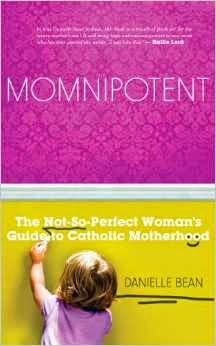
Danielle Bean's Momnipotent: An Incomplete and Slightly Quirky Review ;)
A few months ago, I was vaguely aware that my online friend Danielle Bean had a new book being published about being a mom. Honestly, I didn't really click any of the links about it. One day, I got an e-mail from a local friend who had read a sample of Momnipotent online, and was amazed to discover (as was I!) that I was mentioned in this sample.
Naturally, I had to go find and read it for myself (click here to read the excerpt), and was delighted to discover that Danielle had taken a concept that I apparently helped introduce to the Catholic homeschool world, that of Age Quod Agis (which means "do what you are doing"), and run with it in a really beautiful and helpful way.
The really funny part for me is that reading that excerpt from her book was exactly what *I* needed to read at the time - both to be reminded of the concept of Age Quod Agis and the gist of what she was drawing out of it. The experience made me think that maybe sometimes God does put something out there with your name on it just so that *you* will pay attention. ;)
I'm looking forward to reading the whole thing soon.
Thursday, October 13, 2011
Rejoice in the Good!
The Pontiff noted how "we are always attentive to problems and to difficulties," but there is almost an unwillingness "to perceive that there are beautiful things that come from the Lord."This is something I often bring up in my talks on culture - to rejoice in the good. I bring this up not because I'm good at it, but because I know it's important, yet often struggle with it myself.
Attention to the good, "which becomes gratitude," he said, "is very important for us; it creates in us a memory for the good and it helps us also in times of darkness."
"God accomplishes great things, and whoever experiences this -- attentive to the Lord's goodness with an attentiveness of heart -- is filled with joy," the Pontiff affirmed.
You can read the rest of his talk here: Don't Get Lost in Problems, says Pope.
And speaking of being grateful for the good, 35 men from the Pontifical North American College at the Vatican were ordained deacons last week. You can see a photo here: (the settings won't let me share it). The deacon on the far left was stationed at our parish for the last three summers. We are so happy for him!
I have yet to type up my notes from my conference talk in Napa last summer. Maybe this will remind me to get to it soon. Have a beautiful day!
Tuesday, March 29, 2011
Ignatian Retreat Notes
(I'm getting rid of a lot of paper around here and thought I'd type these up quick and then get rid of the scratch paper.)
This is from a really wonderful Ignatian Retreat with Fr. James Kubicki (director of the Apostleship of Prayer) that I attended last fall...
I was reading Caryll Houselander's Reed of God and Hans Urs Von Balthasar's Does Jesus Know Us? Do We Know Him? (which are both wonderful books!) during the retreat, so a few of the notes may be related to the interconnections... I don't exactly remember!
Talk 1. Love -
"Anyone who loves God in the depths of his heart has already been loved by God. In fact, the measure of a man’s love for God depends upon how deeply aware he is of God’s love for him. - Diadochus of Photice"
Talk 2. Meaning -
Ways of Knowing - Wissen, KennenTalk 3. Letting Go/Surrendering/Death
We appreciate the beautiful partly because it is uncommon, e.g. experiencing the love of God in prayer."It is the blight man was born for, it is Margaret you mourn for..." Gerard Manley Hopkins
Psalm 90
St. Ignatius - Major decision - imagine yourself at death and consider what you wish you had done. Do you organize your day according to your ultimate purpose? The things of this earth are designed to help us attain our ultimate end - hang on to what helps, let go of what doesn't.
Reflect on... Imagine your eulogy. How do you want to be remembered? How does that mesh with reality? What is our "whole life"? What is most important to you?
Talk 4. Sin
We're created by love and for love.Freedom - we must be capable of choosing or rejecting love. Why doesn't God stop us from doing bad things?
The laws of God are built into our nature - we suffer natural consequences when we violate these.
"We're not punished for our sins, but by our sins."
We have, deep down, a sense of fairness.
Three Hebrew words for sin - breaking of relationship, being off target, ?
Prepare for Reconciliation -
Luke 19: Zaccheus - lesson: hurt people, hurt people (recycling hurt)
2 Samuel: 11 - David's Sin - Shirking responsibility, objectifying other people. (objectification)
St. Augustine Confessions - "Our hearts are restless until they rest in you." ("idolatry")
Book note: Ignatius of Loyola: Founder of the Jesuits - His Life and Work by Candido de Dalmasus, S.J.
Talk 5. What was Jesus' greatest joy? Answer: Forgiving
Mark 2, Luke 15Spiritual healing and forgiving sins above physical healing.
Prodigal Son - Listen to pain.
Body of Christ - John 20 + "Saul, Saul, why do you persecute me?"
James 5
In things like AA, it's people who are honest that are able to recover. When we are honest with another person, it confirms that we have been honest with ourselves and God.
The closer we get to God, the more aware we become of our faults and how we have responded/not responded to God's graces.
Talk 6. Life of Jesus
(Note: Corresponded beautifully with the Advent Section of Reed of God that I had just finished.)Romans 7
We can't save ourselves. We cannot change another person, we can only change ourselves, but really it is God who changes us with our cooperation.
"I'm only human" excuse - but we were created for something better, for example, Jesus and Mary. We look to Jesus to see what it means to be human. (c.f. Does Jesus Know Us? Do We Know Him?)
God doesn't impose himself on us - he proposes... doesn't compel, but invites.
Romantic love is dazzling, parental love wins in endurance.
God as suffering parent (with wandering adult child, you cannot force them to change).
Sharing suffering will bring us closer to God.
JPII - Letter to Women - Women see persons with their hearts.
Augustine - "If you can comprehend it, it's not God."
How would you explain color to a blind person?
Assignment... Imagine Annunciation and Birth of Jesus
Note: Bethlehem means "House of Bread"
Talk 7. What is the grace I'm seeking on this retreat?
To know Him, to love Him, to follow Him."See thee more clearly, love three more dearly, follow thee more nearly."
Hebrews 4: Word of God is living and effective.
What is forming our attitudes?
"Ignorance of Scripture is ignorance of Christ." St. Jerome
Romans 8:28 "God makes everything work for the good of those whom he loves."
At the time of St. Jerome, translating into Latin *was* the vernacular. Jerome studied Hebrew and Greek to distract himself from sexual temptations. What was Jesus like? Hebrews 2 - became like His brothers in every way. Hebrews 4 - Not unable to sympathize with our weaknesses... tested in every way. Hebrews 5:8 - He learned obedience from what he suffered when He was made perfect. He grew physically and emotionally and spiritually. Obedience perfected on the cross and in the garden of Gethsemani - He struggled!
Problem: All or nothing approach to faith and virtues. Reality is we're continually working on all these things. Act as if! Act your way into feeling. Virtues are acts of will - not a feeling! Dry prayer is very efficacious.
Two common problems (filled out from above):
1) All or nothing - thinking we're either brave or fearful, etc. when it's really by degrees.
Kind of Calvinistic, really, if you have faith you've got all the virtues in spades - you're saved!
But life *is* a struggle - We're continually (or should be) striving to attain these virtues.
2) Virtues aren't feelings, but acts of the will. Dry prayer through struggles is particulary efficacious.
Act as if! Act in the right way and the feelings will follow.
Remember Blessed Mother Teresa (I need to read this book!)
She felt only emptiness and darkness with regard to her relationship with God, but eventually came to love her darkness, accepting it as part of the suffering of Christ.
Talk 8. Lectio Divina
Imagine the scene as if we were there. "Talk" to people in the story, really enter into the scene.The only way the virtues grow and develop is through exercise, and that's hard! Find an exercise you like.
Teresa of Avila - I never prayed without a good spiritual book n ext to me. She would pick it up whenever she needed inspiration, help with distraction, etc.
True humility is honest and gives glory to God. (c.f. our pastor - Remembering that God is the creator and we are the created.)
True humility is not thinking less of yourself, but thinking of yourself less. Putting the spotlight on God and on other people.
Try to imagine what Jesus thought and felt: joy, affection, impatience, anger, sorrow (all of our emotions, but with divine intensity). Jesus liked some people more than others - e.g. favorite disciples. Different than loving some people more than others. Love is not a feeling, but an act of the will.
e.g. Impatience is not a sin, but a feeling. What we do with it can be a sin.
The appropriate response to injustice is anger. There are things in this world which we're supposed to get angry about. The anger should energize us to right the wrong. Jesus wept. St. Paul cried.
Entering into t he mind and heart of Jesus. Think about getting into the part as an actor in a movie. Not what would Jesus do, what would he think or feel? How do things look to him.
Book Reference: In the Footsteps of Jesus by Bruce Marcciano
Read the Gospel, try to go deeper. Take on the mind and heart, thoughts and feelings of Jesus.
Talk 9. Definitive expression of God's love for us.
Becoming more aware of how much God loves us so we can love Him more.Deus Caritas Est - True definition of love can be found in the pierced side of Jesus.
Who stood under the cross - John and a group of women.
Sources - A Doctor at Calvary, Video - How Jesus Died, "On the Physical Death of Jesus Christ", from a medical journal.
Garden of Gethsemane - Jesus sweated blood (mentioned in the Gospel of Luke - remember that Luke was a doctor) - caused by great stress, leaves skin *highly* sensitive. Not just anticipating his death - Jesus was tempted in the Garden.
39 limit of scourging hits - he didn't scream, was silent, made soldiers more brutal.
Isaiah 53, Isaiah 52
Ecce Homo
The beam weighed 125 lbs. Was tied to his arms, he walked a disatnce of 650 yards and carried the cross across his shoulders.
Loincloth in deference to Jewish sensibilities.
Nails were through his wrist. No artery severed, but medial nerve hit - incredibly painful.
Crucifixion is a slow process of suffocation, which includes a need to push off of the nail through the feet in order to breathe.
Seven Last Words:
1. Father forgive them... (Luke 23:34)
2. This day you will be with me in paradise (Luke 23:43)
3. Woman, behold your son. Behold your mother.
4. My God, My God, why have you forsaken me. (Matthew and Mark) quoting Psalm 22
5. I thirst. Darkness? (John 19:28)
6. It is finished. (i.e. accomplished)
7. Father, into your hands I commend my spirit. (Luke) quoting Psalm 31
This is a related piece from Does Jesus Know Us? Do We Know Him (Von Balthasar) that I was reading at the time:
But it is quite possible to speak of the Son of God suffering what the sinner deserved, i.e., separation from God, perhaps even complete and final separation...Physical suffering on the cross - suffocation, blood loss (racing heart, heart failed), shock.
With every fiber of his being he clings to the God whose presence he no longer feels, because now, in the name of sinners, he is to experience what it means to have lost contact with God...
In the New Covenant we have the experiences of the saints. If genuine, they can only be interpreted as a gift of participation in the Son's forsakenness. John of the Cross, for instance, does not hesitate to describe the dark night of the soul as a kind of experience of hell. God has left the soul and it knows that this must be timeless and hence ultimate. Being truly forsaken by God always has this definitive quality: there can be no forsakenness 'for a time' or involving room for hope. Other mystics in this situation have felt, not only that 'it will always be like this', but 'it has always been like this': they experience a kind of eternity of this 'hell' from which no one can deliver them but God himself. And he has disappeared.
Again, it is unthinkable that people following Christ should have had to go through more terrible experiences than their Lord himself; their experiences can only be a muted echo of the unique and incomparable burden which the God-Man endured.
Pierced side - blood and water. We come from the side of Christ! Blood - Eucharist, Water - Baptism
At the end of the parable of the lost sheep Jesus recalled that God's love excludes no one: "So it is not the will of your Father who is in heaven that one of these little ones should perish." He affirms that he came "to give his life as a ransom for many"; this last term is not restrictive, but contrasts the whole of humanity with the unique person of the redeemer who hands himself over to save us. The Church, following the apostles, teaches that Christ died for all men without exception: "There is not, never has been, and never will be a single human being for whom Christ did not suffer." (Catechism of the Catholic Church #605)Christ suffered for all. We need to accept this love.
Talk 10. Happy Easter!
Every Sunday is a little Easter.Risen body of Jesus still had the wounds.
"Have you anything here to eat?"
Corinthians 1:15 - How are the dead raised?
John 20 - story of St Thomas (doubting): "My Lord and My God"
Think about Heaven - Hebrews 12 - Cloud of Witnesses - waiting to welcome us (the saints).
Who will welcome you? Who are you eager to meet?
No goodbyes in Heaven - one big reunion.
St. Thomas Aquinas on Heaven:
a. the person is united with God
b. compete satisfaction of desire
c. joyous community of the blessed
Good things on earth are little appetizers of the heavenly banquet.1 Corinthians 2: What God has prepared for thsoe who love him. God cannot be out done. You cannot outdream God.
Monday, November 03, 2008
Another Quote regarding "Rejoice in the Good"
Today I read the book of Tobit aloud to John and the kids in preparation for our catechism discussion tomorrow night. I thought that this particular quote was particularly pertinent:
And the angel called the two of them privately and said to them: "Praise God and give thanks to him; exalt him and give thanks to him in the presence of all the living for what he has done for you. It is good to praise God and to exalt his name, worthily declaring the works of God. Do not be slow to give him thanks." (Tobit 12: 6)
Friday, September 26, 2008
I Think This Especially Applies to Curriculum Choices...
There are two types of decision makers. Satisficers (yes, satisficers) make a decision once their criteria are met. When they find the hotel or the pasta sauce that has the qualities they want, they're satisfied. Maximizers want to make the best possible decision. Even if they see a bicycle or a backpack that meets their requirements, they can't make a decision until they've examined every option. Satisficers tend to be happier than maximizers. Maximizers expend more time and energy reaching decisions, and they're often anxious about their choices. Sometimes good enough is good enough.
Tuesday, March 11, 2008
Beating the Winter Blues
Yesterday we took a break from school and had another family over. We had a picnicky potluck (somewhat limited by all of our Lenten observances, but VERY nice all the same), watched Ben Hur (the littles watched something else and played in the another room) and enjoyed lots of laughter and each other's company.
And if you happened to be in our area and saw two moms and a bunch of kids jumping up and down on the deck outside at one point (and laughing and high-fiving each other), there really is a very sensible and refined reason for it all. You see, we went outside to enjoy a little sun (the very, ahem, moderate temperature of 32 degrees, combined with sun and shelter on the south side of the house was awfully nice, even in stocking feet) and somehow discovered that when we stomped or jumped on the deck, the icicles under the deck broke off and crashed to the ground with a very satisfying glass-breaking sort of noise.
The silliest part, really, is that I didn't plan this in relation to Daylight Savings Time at all (Daylight Savings Time didn't enter my head at all until I saw Danielle Bean's reminder on Sunday Morning), but it was really a perfect day for such a get-together.
Monday, December 31, 2007
Why I Love Celebrating Christmas for 12 Days
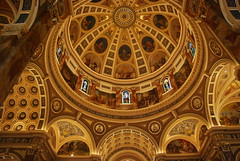
2. It allows us to spend our Christmas Eve Vigil Mass in the "stable" of our church gymnasium in order to attempt to provide many who attend Mass only once a year with a more beautiful and meaningful liturgy (musically speaking) and yet still celebrate Christmas the following Sunday in one of the most beautiful churches I've ever been in (the inside of the dome of St. Josaphat's Basilica is pictured here - click here for more photos). Ria did manage to go to Christmas Eve Midnight Mass later that night with her grandparents (who very kindly brought her back in time for opening presents on Christmas morning) and Gus and I watched Midnight Mass from the National Shrine in D.C. via EWTN.
3. It gives me an excuse to play loads of games of Settlers of Catan (one of the very favorite Christmas presents this year) with the kids and encourage them to keep baking Christmas goodies, even though John had to work for a few days last week. (I hardly ever do any baking any more as my kids love it - warning: it does get messy!)
4. The same goes for listening to Christmas Music.
5. I get to take advantage of crazy after-Christmas sales to supply fun little presents for between Christmas and Three Kings' Day - such as the dollar section at Target at 75% off! :) Yesterday was a day that everyone got to open an item of clothing courtesy of Kohl's 80-90% clearance sections and $20 in Kohl's cash.
5. Many of things people try to cram in before Christmas are still open the week after Christmas too. On the third day of Christmas we went to a fun drive-through light show with John's parents and lots of Christmas music on the car CD player, followed by an indoor look at an amazing nativity set and a fun and enormous set of electric trains.
Also, after visiting the Basilica yesterday, we went to the Milwaukee Public Museum and particularly enjoyed the "European Village" (here's a sample photo, though I can't remember which house this is from - Ria thinks it's the Austrian one) in which each exhibit was still decorated for Christmas and Christmas music was playing throughout. What fun - and this was completely unexpected for us - I never knew that they decorated these houses for Christmas!
6. We still have more time in which to send out our long-neglected Christmas Cards!
Tuesday, December 11, 2007
For Margaret :)
You see, after a lot of hemming and hawing, I decided to cancel our Friday night lit discussion because three homeschool events in our house three days in a row seemed a little intimidating, AND I was going to have a difficult time finishing the reading and preparing for the Latin Club party the next day AND I thought we should get to the Vigil Mass for the Feast of the Immaculate Conception as the next day was going to be rather crazy.
Somewhere in the midst of cleaning, I found some slightly used foam board that, it seemed to me, would make a wonderful obelisk for the middle of our sunroom and most appropriate to the party. It was to be, more-or-less, a model of the obelisk in St. Peter's Square which we had learned about at the Papal Exhibit that came to our local museum a few years ago. Read more about the real obelisk here if you like.
Here's is my initial result before running off to do some shopping (and get some more foam board and a can of spray paint) and before coming home and suggesting to John that maybe he'd like to make it with the kids.

He reluctantly accepted the task after I assured him that I could handle the dinner and the cleaning preparations. I was enthusiastic about the idea of them building this together. He dug right in, as any good engineer would do, and made proportionate measurements based on a real photograph we found on flickr.

They had a great time piecing things together, though the younger set went to bed in tears because they wanted to watch Daddy spray-paint the new structure in the basement, but they had passed the deadline for bedtime (which was being rather strongly enforced since we discovered that our parish for some reason didn't have a vigil Mass but only offered an 8:30 Mass the next morning for the Feast Day). I was just getting up from settling Frank down to bed when I opened the door and smelled something. Ugh.
The paint smell was going to be bad - and get worse. I started by cracking a few windows open downstairs, but soon realized it wasn't going to do. So I threw some extra blankets on the kids
and cracked their windows open. Soon I had the kids in the upper bunks relocating to lower bunks (the smell was definitely stronger up there!) and threw the windows wide open. The three little girls were delighted with my suggestion to all snuggle up in Kate's bed ("Little House on the Prairie" style) and share all of their blankets (at this point a considerable pile) together. They were SO warm that they asked to keep the windows open longer than we actually needed to! Naturally they're posing in this shot...

Frank was snug in a double-fleece blanket plus a down comforter. He never even stirred from the cold.
After about an hour, the smell had fully-dissipated and were able to close the windows and turn the heat back on. It was nice that there was no wind as that would have made things too cold too fast!
The real bummer was that, after all that trouble, the one can of spray paint didn't come close to covering the entire obelisk. It was a curious thing to compare to a paint job we once did to the entire exterior of our old house (just before we sold it) which only took five gallons of paint to accomplish the job!
The result, nevertheless, was quite satisfying. It was a fun addition to the party and the kids decided to bring it along to next month's state JCL convention - after giving it a fresh coat of paint of course. :)
And, in this picture, you can hardly see the silver electrical tape with the red imprints on it. This is a picture from the Latin Bingo game at our party the next day.
Thursday, December 06, 2007
Sometimes it's Really Easy to be Nice
Thursday, October 25, 2007
40 Reasons to Have Kids
I started this awhile back, got distracted with reading through our funny kiddie quotes collection on Studeo and just decided to get back to it...
You've probably seen Karen's and Ana's lists of "40 Reasons to Have Kids" (I think someone since turned it into a meme). I couldn't resist getting in on the fun (and you know how much I love lists!) with my own angle. These are real moments or memories that in some way symbolize for me the joy of being a mom - I know that a part of this for me is the freedom that kids offer in the way of making me comfortable being myself (what kid ever cares if your hair or makeup is done or your socks match?) and provide the freedom of being child-like. I guess I should go beyond that and say that they help remind me of how to look at the world in a fresh, non-jaded way. Which is a good thing!
1. Younger siblings learning from older siblings.
2. The laugh-out-loud comedic aspects of life with kids that you could never have come up with on your own.
3. Their beautiful, and sometimes hilarious, love for and encouragement of each other.
4. Listening to them confuse the English language in exquisitely delightful ways.
5. Once in awhile their confusion rubs off on their parents.
6. Christmas
7. Easter
8. First Communions
9. Baptisms
10. Toddlers trying to talk with their mouth full (especially while nursing!).
11. Theological (and practical) tidbits the little ones share with you during Mass.
12. Parades any time at all.
13. Reading aloud favorite books to them.
14. Having them start to read books aloud to their siblings and listening to them stop and giggle at the funny parts.
15. The enthusiasm and sense of wonder that kids bring to the world.
16. Having them read (and fall in love with) your favorite books.
17. Halloween costumes (though perhaps not the candy-monster after effects).
18. Costumes any time at all.
19. Silly family traditions - like the little song we sing when we cross a state line and holding our hands up when we drive through a tunnel.
20. Skipping through parking lots.
21. Singing in the car.
22. The famous Van Hecke bird show dash at the Wild Animal Park. (LOL)
23. Learning together, even when we sometimes present a bit of a distraction.
24. The joy of solving problems together, despite grief along the way.
25. Cooking with kids (or even letting kids cook).
26. The beginnings of philosophical discussions.
27. Giggles.
28. May crownings
29. The thrill of seeing them overcome tough obstacles.
30. Kids and animals are always an entertaining mix and sometimes very touching too.
31. The wonderful smell of chrism that lingers in a baby's hair for many days after they are baptized.
32. Toothless grins.
33. Sharing sweets with your kids - it divides the calories and is a LOT more fun than eating sweets alone.
34. Newborn sweetness.
35. Sharing the joy of exciting accomplishments.
36. An incredible amount of comfort in times of sorrow.
37. Watching your kids fall in love with a brand new sibling.
38. Playing Mother Duck (I just noticed that I first reconnected with Nutmeg in the comments of this old post!)
39. The crazy things they do that make you suppress laughter even while remaining, ahem, stern on the outside.
40. Road trips to see family and friends - especially COUSINS!
Tuesday, October 23, 2007
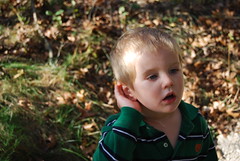
Frank Listening
I love this photo of Frank showing how he likes to stop and listen during our walks (I did ask him to stop and show me again so I could take a picture). Something he's picked up along the way from his siblings. :)
Thursday, October 18, 2007
Old World Wisconsin
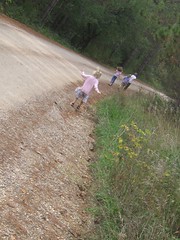
We managed to have a very nice visit to Old World Wisconsin yesterday afternoon (hurray for cancelled activities - even ones we love!). Nothing like exercise and outdoors to enjoy a beautiful fall day.
All together there was a great deal of singing and skipping going on.
(photo by Ria)
Thursday, July 12, 2007
Things that made me happy this week...
Not in any particular order...
Meeting a good friend's sweet new baby.
Getting this comment on one of our photos from de Smet over on flickr...
I have wanted to visit De Smet for ages. This set is wonderful and much-appreciated. :)Getting asked by a priest if I can help him learn to pronounce the Latin in the 1962 Missal for use after the Motu Proprio goes into effect on September 14.
Playing around with blog templates. (And, of course, chatting with Margaret on the phone.) ...especially since in so doing I figured out at least one thing to implement on my own site that I've been wanting to do. (Neither template is finished yet, by the way. You have to let these things stew for just a bit.) :)
Having a delightful discussion on Pope Benedict XVI's Jesus of Nazareth with our teen group (the pizza and cookies didn't hurt either!).
Getting to chat with Ria and Gus about our discussion on the drive home.
Vicariously experiencing my in-laws' month in Spain through their shared journals and photos. Working on drawing a big map of Spain with Gus to locate all the places they've been visiting.
Watching Miss Potter. It has one of the most charming proposal scenes I've ever seen on film.
Reading lovely posts like this and this and this on friends' blogs.
Discovering that some other mom-bloggers are also friends and admirers of Fr. Warren.
Bernie's (and Terri's!) lunch yesterday
Having steak for dinner, compliments of Aunt A. Yum!
Friday, April 06, 2007
Fr. Groeschel sheds more light on "Age Quod Agis"
Part of temperance is taking care of ourselves. Obsessive-compulsive workaholism is obviously not a sign of temperance. Even if we enjoy our work, we need to practice temperance and get adequate rest. Careful, Benedict!
Enjoy what's going on while it's going on. If you go to the supermarket, enjoy it. Don't make it drudgery. Talk to the cashier. Speak to the people at the fruit counter. Chat with a neighbor. Try to get to know people, get them to talk to you, and make your passage through life pleasurable. If you are a private person and find it a chore or somewhat difficult to speak to strangers, at least smile. As an old extrovert, I deeply appreciate a quiet person with a genuine smile; in addition, such a person listens to us, which practically no one else does.
Slow down. Smell the flowers as you go by, and then you won't need too much of this world's goods. Enjoy your work and you won't need too much time off. Enjoy being at home and you won't have to go away so much.
Many people are intemperate because they are miserable and suffering. Their life is a big long misery, so they decide to brighten it up with mountains of potato chips. They're addicted to potato chips or sweets or even beer. Look at your own intemperateness and see if unhappiness is causing it.
Friday, March 23, 2007
Fr. Thomas Dubay on Age Quod Agis
Little children live intensely in the present moment, neither in the past nor in the future. As the French writer La Bruyre once put it, ‘Children have neither past nor future, but they have something we seldom have—they rejoice in the present.’I found the quote here. Click here to read my old posts (and links to others' posts) on this topic.
This is the child-like trait which the New Testament would have us imitate. Age quod agis—literally, ‘do what you are doing’…The future does not yet exist and the past is gone forever. What we have is the present moment. By it we are fashioning our eternity.… Fr. Thomas Dubay, SM, LIVING FAITH, Sept. 30, 2002
It's kind of funny to find this quote by Fr. Dubay, because I think I first mentioned this old Latin motto in a post about one of Fr. Dubay's books - but only because it reminded me of the motto, which I found in another book by a different author. It's neat that Fr. Dubay also appreciated this phrase; this quote is the nicest elucidation of the concept that I've come across.
Wednesday, October 25, 2006
Age Quod Agis Gets Around
![]() |
| Ria, circa 1994 |
I had recently discovered this motto in the book Lunch Bag Notes (from Loyola Press). I was at the library by myself - my husband stayed home with the kids. I always have a tendency to feel guilty and rush through these things, (gotta hurry, gotta hurry) but this time I thought "What am I doing?" - I'm running myself ragged. There's nothing wrong with slowing down and enjoying the process a little more of selecting books for my family's education, etc. etc. Do what you are doing!
Anyway, here are some links to other moms' thoughts on Age Quod Agis.
Willa R.
Karen E.
Danielle Bean
Thursday, August 24, 2006
The Seven Habits of Highly Effective New School Years:
1. Remember that regular learning and effort are far more important than one child, one subject, one year, one textbook.
2. Don't do for children what they can reasonably do for themselves.
3. With children we need to think "effective" rather than "efficient" (with another hat tip to Steven Covey)
4. Achieving a balance is key in so many areas (structure vs. flexibility, "In the world but not of the world", etc.)
5. Cultivate a love of the good and a desire for the truth - our goal is to have our children choose these for themselves.
6. Knowledge and virtue are both important, but they're not the same thing.
7. Age quod agis. This phrase, which means "Do what you are doing" helps remind me to not be in such a hurry or get frantic about all that needs to be done. Focus on the thing at hand and don't drive yourself crazy.
Thursday, January 05, 2006
Some thoughts on offense and conversion
I finally settled on a little spiritual reading and pulled out Cardinal Ratzinger's Introduction to Christianity. Good choice. Just what I need right now.
Here is a little story I want to share from the book. I love how Ratzinger shares a Jewish story in a book introducing Christianity. That in itself is interesting and wonderful for a lot of reasons. But here is the story (in the first chapter on "Belief in the World of Today.")
An adherent of the Enlightenment [writes Buber], a very learned man, who had heard of the Rabbi of Berditchev, paid a visit to him in order to argue, as was his custom, with him too and to shatter his old-fashioned proofs of the truth of his faith. When he entered the Rabbi's room he found him walking up and down with a book in his hand, wrapped in thought. The Rabbi paid no attention to the new arrival. Suddenly he stopped, looked at him fleetingly and said, "But perhaps it is true after all". The scholar tried in vain to collect himself - his knees trembled, so terrible was the Rabbi to behold and so terrible his simple utterance to hear. But Rabbi Levi Jizchak now turned to face him and spoke quite calmly: "My son, the great scholars of the Torah with whom you have argued wasted their words on you; as you departed you laughed at them. They were unable to lay God and his Kingdom on the table before you, and nor can I. But think, my son, perhaps it is true." The exponent of the Enlightenment opposed him with all his strength; but this terrible "perhaps" which echoed back at him time after time broke his resistance. (pgs. 20-21, cited from M. Buber, Works, Vol. III, Munich-Heidelberg, 1963, p. 348)
It contains a great deal of truth in itself, but also reminds me of some other tidbits about conversion - like Evelyn Waugh's "Tug on the Thread" from Brideshead Revisited and even this little piece I was reading today from Barb Nicolosi's blog. Her blog has a tendency to keep my perspective in check. She's a little feisty, perhaps, and I'm sure some take offense at her strong opinions. But I think it's easy today to become a too-comfortable Christian with lots of leisure to be offended by things. We're not going to win the culture war by being offended and boycotting organizations that offend us. A particular organization may choose not to offend us in the future, which isn't a bad thing, but no hearts will be changed and moved by this.
I think we need, on occasion, to swallow some of that offense in order to look at what other people need and see what we can do to change the culture, even in a very small way. If we can stand having an open, honest discussion with someone who doesn't believe, or who doesn't see the world the way we do - one in which we do a lot of listening and trying to understand - we can perhaps just plant a little seed. But maybe that seed will turn out to be a mustard seed, eh?
This to me is part of the joy of homeschooling. I can teach my children (with the assistance of God's grace through prayer and the sacraments) to enjoy and appreciate the fullness of the Church's teachings and the Unity of Truth, the "marriage" of faith and reason. They can appreciate Science partly because it is learning about God through his creation (and partly because it's fun and interesting - why should we be surprised at that when God is ALL goodness). They can see how great works of literature, sometimes inadvertently, will tend to confirm timeless teachings of the Church. They can build their own "skeptometer" in order not to be swayed by everything they read, but to "test everything and hold fast to what is true" (I'm paraphrasing here). And perhaps someday, they will go out into the world and be more interested in planting seeds (ESPECIALLY mustard seeds! [grin]
Sunday, January 01, 2006
Age quod agis
Do what you are doing.
Wednesday, October 26, 2005
Finally Getting Back to Dubay's Authenticity
Dubay really packs a punch. His material is challenging. Not so much in the sense of difficult to understand, as forcing the reader to examine their own conscience and look at themselves in a more complete way.
Some notes and quotes:
Scripture says a great deal about the conditions necessary before one is uncluttered enough to detect the gentle voice of God speaking in the depths of the person. (pg. 25)
We live very cluttered lives here in the 21st century.
Authenticity is reality without sham. (pg. 26)
Awesome
The human person must be whole to be completely authentic. ... There is only one enough for man, and that is the divine Enough. Anything less is incomplete, truncated... The Father made us in the image of his Son, so that anything less than conformity to this image is a falling away from the authentikos, the original. 'The disciple of Christ consents to live in the truth, that is, in the simplicity of a life in conformity with the Lord's example, abiding in his truth (CCC 2470).
The genuine man or woman measures up to the real, to the factual situation. He is humble because he knows and professes himself to be neither more nor less than he actually is. He is single-minded in his pursuits, for he operates with the pure motivation of eating and drinking and doing all else for the glory of God (1 Cor 10:31).. He accepts the whole gospel, not simply the popular, pleasant parts of it. He welcomes correction because he knows himself to be ignorant of many things and a sinner besides (Prov 9:7-9)... Especially is he authentic because he is a total lover of God, and love brings all the other ingredients of authenticity (1 Cor 13:4-7). (pgs. 26-27)
This last part reminds me of a Latin proverb that came up in Lunch Bag Notes by Al and Ann Marie Parisi (Loyola Press). The proverb is...
Age quod agis.
"Do what you are doing." I really like that (and need to be reminded often!).
Part of living the truth is an acceptance of a reasonable dependence on others, an acknowledgement of a need for admonition and advice. (pg. 33)
This is so true. I think we homeschool moms especially need to be reminded. A lot is expected of us and we're doing a lot. Sometimes we think we're failures if we can't do "everything". Or we think it's wrong to burden someone else with our problems. But the Sacrament of Marriage doesn't guarantee that we'll be able to handle every single one of our children's needs without assistance. There's nothing that says we'll be good at teaching Algebra or handling every teaching challenge that comes our way. I always like the analogy (can't remember where I read it) that homeschool parents are like contractors on a construction project - an important part of the job is finding people/resources for tackling parts of the job. The contractor isn't inadequate if he can't do everything himself.
Most people tend to allow the truth they possess so to dominate their thinking that they see few other truths that place their one truth in perspective and balance it out. There is probably no heresy in the history of the Church that did not have its truth. The problem invariably is that the one truth so took over the heretic's mind that he was committed to cast out any number of other doctrines that clashed with his interpretation of it. (pg. 34)
This is a really challenging concept and it can be tempting to blow it off as just politically correct, "open-mindedness" stuff. But it's not. One example that struck me was that we can be so passionate about a cause that we can throw the virtue of prudence out the window and end up hurting the very cause that we care so passionately about. (An example of this might be a pro-Lifer who decides to use violence to accomplish his goals.) This segment reminds me of a term I like better than "open-minded", and that is "broad-minded."
Philosophers have long noted that error proximately is due to an extension of one's judgment beyond evidence. (pg. 37)I really liked that phrase "an extension of one's judgment beyond evidence." Very helpful to remember.
Good stuff.